
Electric Baseboard Heating Explained
Updated 2026-08-16 · 8 min read
Gear this guide recommends
We earn a commission if you buy through links on this page, at no extra cost to you. It does not change what we recommend. See our affiliate disclosure. As an Amazon Associate I earn from qualifying purchases.

Line-voltage smart thermostat (120–240 V)
Mysa Smart Thermostat V2 for Electric Baseboard Heaters
Best for: One room of electric baseboard heat, replacing a dial or basic line-voltage thermostat
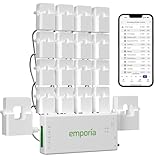
Whole-home energy monitor
Emporia Vue 3 Home Energy Monitor (16 circuit sensors)
Best for: Measuring hardwired and 240 V loads, or every circuit at once
Jump to a section▾
Electric baseboard heat is the simplest heating there is: current through a resistance element, warmth by natural convection, one thermostat per room. No ducts, no combustion, no outdoor unit, almost nothing to fail.
The trade is stark. Cheapest to install, most expensive to run. Whether that's the right trade depends entirely on how much heating you need.
Baseboard heat, sized and costed
| Room | Typical baseboard |
|---|---|
| Rule of thumb | ~10 W per sq ft, well-insulated |
| 100 sq ft bedroom | ~1,000 W |
| 200 sq ft living room | ~2,000 W |
| 400 sq ft open area | ~4,000 W |
| Electric baseboard | Heat pump | |
|---|---|---|
| COP | 1.0 | 2.5–4.0 |
| Install cost | Low | High |
| Running cost | Highest of any electric heat | ~⅓ |
| Per-room control | Excellent | Zoning needed |
| Cooling | No | Yes |
Baseboard is cheap to install, silent, and the most expensive electric heat to run: one watt in, one watt of heat out, with no multiplication. It makes sense for rarely used rooms, additions, and as a low-capital stopgap; it does not make sense as primary heat if a heat pump is affordable.
How does electric baseboard heating work?
A resistive element inside the heater warms up. Cool air enters through the opening at the bottom, is heated as it passes the element and fins, and rises out the top. That convection loop circulates air through the room with no fan.
Two consequences follow directly:
- The openings must stay clear. Blocking the bottom inlet or the top outlet stops the convection loop and creates a fire risk. Manufacturers specify clearances; respect them.
- Placement matters. Traditionally installed under windows, because the rising warm air counteracts the cold downdraft off the glass. That's still the best position.
Efficiency is fixed at 100% at the appliance: every watt of electricity becomes a watt of heat. That sounds excellent and is exactly the problem: it can never do better. A heat pump moves existing heat instead of creating it and delivers 2–4 units of heat per unit of electricity. See heat pump vs electric resistance heat.
Sizing
Baseboards are sized in watts, and heaters are sold by length with a watts-per-foot rating.
The rule of thumb: roughly 10 watts per square foot for a reasonably insulated room in a moderate climate. Adjust upward toward 12–15 W/sq ft for:
- Poor insulation
- Large or single-pane glazing
- Multiple exterior walls
- Cold climates
- Rooms above unconditioned space
The better approach is a room-by-room heat loss calculation, which accounts for actual insulation levels, window area and orientation, and exterior surface. A rule of thumb applied to a poorly insulated room with three exterior walls will undersize it.
Length matters as much as wattage. A longer heater at lower watts per foot distributes heat more evenly and runs at a lower surface temperature than a short high-output unit, generally more comfortable and safer. Fit the longest heater the wall will take.
Insulate first. Because resistance heat is the most expensive per unit delivered, envelope improvements pay back faster here than with any other heating type. Air seal and insulate, then size; see how to air seal a house and attic insulation R-value guide.
Electrical requirements
This is proper electrical work: permit, inspection, and NEC compliance.
Voltage. Most residential baseboard heat is 240V, which halves the current for a given wattage compared with 120V and allows longer runs and smaller conductors. 120V units exist for small supplemental loads.
Dedicated circuits. Heaters are hard-wired to dedicated circuits. Multiple heaters can share a circuit provided the total connected load fits within the circuit's allowance.
Continuous load. Electric space heating is treated as a continuous load, so the circuit and overcurrent device are sized above the actual running current per the NEC. This is why a heater doesn't simply get a breaker matched to its nameplate amps.
Current draw. Amps = watts ÷ volts. A 1,500 W heater at 240 V draws 6.25 A running. Applying the continuous-load factor gives the design current the circuit must be sized for.
Panel capacity. Whole-house electric resistance heat is a large connected load, and adding it can push a service past its capacity. Run the numbers with the home electrical load calculator, and check conductor and breaker sizing against the wire and breaker size reference. If capacity is tight, see 200 amp vs 400 amp service.
Get an electrician. Conductor sizing, breaker selection, box fill and the continuous-load calculation all come from code, and the specifics vary with your local amendments.
Thermostats
Three types, and the difference is real:
Built-in (unit-mounted). Cheapest, and the least accurate: it senses the air right at the heater, which is the warmest air in the room. Expect noticeable temperature swings.
Line-voltage wall thermostat. Mounted on the wall, switching the full heater current. Senses room air rather than heater air, so it holds temperature better. Must be rated for the load it's switching.
Electronic line-voltage thermostat. Same wiring, but with much tighter control, cycling more frequently and holding a narrower band. Noticeably more comfortable, and the reduced overshoot can genuinely reduce consumption. Programmable and smart versions exist.
Important: baseboard thermostats are line voltage: they switch 240V directly. A standard low-voltage thermostat designed for a furnace or heat pump will not work and is not safe here. Match the thermostat to the system and the load.
A smart line-voltage thermostat rated 3,800 W at 240 V (1,900 W at 120 V) for all the heaters it switches:
Zoning is the one real advantage of baseboard heat. Every room can have its own setpoint, so you heat only what you use. Setting back unused rooms is the most effective way to control the running cost.
Running cost
Simple arithmetic: kWh = watts ÷ 1,000 × hours, then multiply by your rate.
Illustrative example. A 1,500 W heater running 8 hours at an illustrative $0.16/kWh: 1,500 ÷ 1,000 × 8 = 12 kWh × $0.16 = $1.92 for the night, per heater.
Multiply across every heater and every heating hour and you can see why whole-house resistance heat produces large winter bills. Work out your own numbers with the electricity cost calculator and your rate from the utility rates reference, then project a bill with the electricity bill estimator.
Reducing it:
- Set back unused rooms: the biggest lever, and it's free
- Insulate and air seal: pays back faster here than with any other heat source
- Electronic thermostats to cut overshoot
- Check for time-of-use rates with your utility, and shift what you can
- Add a heat pump for the main living areas and keep the baseboards as backup and zone heat, often the best-value move in a baseboard-heated house
Where baseboards still make sense
They're not obsolete. Good fits:
- Small or rarely used rooms: a spare bedroom, a home office, a workshop
- Additions where extending ducts or refrigerant lines is impractical
- Backup or supplemental heat alongside a heat pump, covering the coldest days and rooms the main system doesn't reach well
- Very mild climates where the heating season is short and running cost never accumulates
- Buildings where the upfront cost genuinely can't be stretched, accepting the operating cost
- Rooms needing independent control: a nursery, a guest room
Where they don't: as primary heat for a whole house in a cold climate. That's the expensive combination.
Baseboards plus a heat pump
The common upgrade path, and often the smartest one. A ductless mini split handles the main living areas at a fraction of the running cost, and the existing baseboards stay in place as backup for the coldest days and as zone heat for bedrooms.
You keep the resilience and per-room control, and you rarely run the expensive heat. See what is a mini split and ductless vs central heat pump. Check the sizing with the mini split sizing calculator.
Safety
- Keep clearances. Nothing in front of, above, or draped over a baseboard. Curtains hanging down over one are a common and genuine fire risk.
- No furniture blocking the inlet or outlet.
- Don't dry clothes on them.
- Check for damage: bent fins reduce output; a damaged element or scorching means stop using it.
- Don't use extension cords or power strips with any heating appliance; see space heater electrical safety and extension cord safety.
- Warm or discoloured thermostats, outlets or connections mean an electrical problem; see warm outlets and switches.
The bottom line
Electric baseboards are cheap to install, trivially reliable, perfectly zonable, and the most expensive common electric heat to run because resistance heating can never exceed a COP of 1.0. Size at roughly 10 W/sq ft as a starting point but calculate properly, wire to dedicated 240V circuits with the continuous-load factor applied, and use wall-mounted electronic thermostats rather than the unit-mounted ones. They're a good answer for small spaces, additions and backup, and a costly one as whole-house primary heat in a cold climate.
Compare with the heat pump payback calculator, or read heat pump vs electric resistance heat.
Frequently asked questions
Ask AI about this
Open an AI assistant with a question grounded in this page.