
Interlock vs Transfer Switch: Which Generator Connection to Use
Updated 2026-09-30 · 6 min read
Gear this guide recommends
We earn a commission if you buy through links on this page, at no extra cost to you. It does not change what we recommend. See our affiliate disclosure. As an Amazon Associate I earn from qualifying purchases.
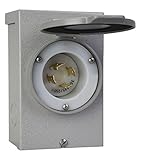
Power inlet box
Reliance Controls PB30 Power Inlet Box (30 A, L14-30)
Best for: Interlock-kit and transfer-switch installs fed by a portable generator's L14-30 outlet
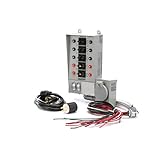
Manual transfer switch kit
Reliance Controls Pro/Tran 10-Circuit Transfer Switch Kit (31410CRK / 310CRK)
Best for: Portable generators up to 7,500 running watts with an L14-30 outlet
Jump to a section▾
Both solve the same problem legally: making it impossible for utility power and generator power to be connected at the same time. They do it differently, and for a portable generator the interlock is usually the better value.
How does an interlock work?
A breaker interlock kit is a metal plate that mounts on the panel's deadfront, over the main breaker and a dedicated generator breaker.
The plate slides. In one position it covers the generator breaker, so only the main can be on. Slide it the other way and it covers the main, so only the generator breaker can be on.
You physically cannot have both on. Not by mistake, not in the dark, not by forgetting a step: the plate is in the way.
It's a purely mechanical solution to a human-error problem, which is why it's accepted as equivalent protection to a transfer switch.
The full installation
An interlock alone isn't the whole job:
- The interlock kit, listed for your specific panel model
- A generator breaker in the panel, sized to the generator's output
- A power inlet box on an exterior wall: a male inlet you plug the generator cord into, so no cord has exposed live pins
- A feeder from the inlet box to the generator breaker
- Permit and inspection
The inlet box and feeder are needed for a transfer switch too, so they're not a differentiator; the saving is in the switch itself and the subpanel wiring it would need.
With an interlock, the inlet box is its own component (item 3 above). For a generator with an L14-30 outlet, Reliance's PB30 is a cULus-listed 30 A, 125/250 V L14-30 inlet in a raintight box, the same inlet Reliance packs in its 31410CRK transfer-switch kit below. Reliance rates it for a transfer switch or a listed interlock kit where the inspector accepts one, and it's installed by the electrician with the rest of the job.
We earn a commission if you buy through links on this page, at no extra cost to you. It does not change what we recommend. See our affiliate disclosure. As an Amazon Associate I earn from qualifying purchases.
Interlock kit or transfer switch: which is better?
| Interlock kit | Manual transfer switch | Automatic transfer switch | |
|---|---|---|---|
| Prevents backfeed | Yes | Yes | Yes |
| Relative cost | Lowest | Moderate | Highest |
| Circuits available | Whole panel | Selected (typically 6–12) | Whole service, usually |
| Load management | Manual: you switch breakers | Built into circuit selection | Automatic load shedding |
| Operation | Manual | Manual | Automatic |
| Works when you're away | No | No | Yes |
| Panel compatibility | Must have a listed kit | Any | Any |
| Panel space needed | Two adjacent positions | None in main panel | None in main panel |
Why the interlock often wins for portables
Cost. Meaningfully cheaper, and the difference is real money rather than a rounding error.
Whole panel access. You can power any circuit in the house; you just have to manage which ones are on. A subpanel transfer switch fixes your choices at installation time; the interlock leaves them open. If you decide next winter that you want the garage circuit, you just switch it on.
Flexibility. Priorities during a summer outage differ from a winter one. An interlock lets you change your mind.
Simplicity. Fewer components, nothing to fail.
Where it falls short
You are the load management. Before switching the generator breaker on, you switch off the circuits you don't want: electric water heater, range, dryer, air conditioning. Then bring loads up gradually.
Forget, and you'll overload the generator. It'll trip rather than break, but it's an inconvenience in the dark, and it's a discipline you have to maintain every time.
Manual only. No automatic operation. If the power fails while you're away, nothing happens. For a standby system that starts on its own, you need an ATS. That's not an interlock's job.
Panel compatibility. Kits are panel-model specific. Most mainstream panels have one; some older or unusual panels don't, and using a kit not listed for your panel voids its listing and will fail inspection.
Panel space. You need two adjacent free positions for the generator breaker, and the interlock has to fit the panel's physical layout. A full panel may need rearranging first. See how many circuits can a panel hold.
Choosing
An interlock suits you if:
- You have a portable generator
- You'll be home to operate it
- You want flexibility over which circuits you power
- A listed kit exists for your panel
- Cost matters
A manual transfer switch suits you if:
- You want the prioritization decided once and enforced automatically
- No listed interlock exists for your panel
- You'd rather not manage breakers during an outage
- Multiple people in the house may need to operate it
For a portable generator, one kit covers it: switch, outdoor inlet box and generator cord in one box:
An automatic transfer switch is required if:
- You have a standby generator
- Outages while you're away must be covered
- Someone in the house depends on powered medical equipment
- You want load shedding so a smaller generator serves a larger house
See transfer switch explained and manual vs automatic transfer switch.
Installation is not DIY
Whichever you choose, installation means working inside an energized panel where the main lugs remain live with the main breaker off, and it's permitted, inspected work in essentially every jurisdiction.
The interlock kit itself looks simple enough that people attempt it. The plate is the easy part; the generator breaker, the feeder, the inlet box, and the neutral bonding decision are not. See generator neutral bonding and electrical work homeowners can legally do.
Standards and code reference
The standards behind this guide, for looking up in the edition your jurisdiction has adopted:
- NEC 702.5: transfer equipment must prevent inadvertent interconnection
- NEC 110.3(B): a listed interlock must be the one listed for that panel
Code editions and local amendments vary. Confirm the adopted edition with your AHJ, and treat manufacturer instructions as governing wherever they are more restrictive.
Where to go next
- How to connect a generator to your house
- Generator inlet box
- Backfeeding dangers
- Size it properly: generator sizing calculator
More in our generator and backup power guides.
Frequently asked questions
Ask AI about this
Open an AI assistant with a question grounded in this page.