
Backfeeding a Generator: Why the Suicide Cord Kills
Updated 2026-08-16 · 6 min read
Gear this guide recommends
We earn a commission if you buy through links on this page, at no extra cost to you. It does not change what we recommend. See our affiliate disclosure. As an Amazon Associate I earn from qualifying purchases.
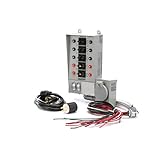
Manual transfer switch kit
Reliance Controls Pro/Tran 10-Circuit Transfer Switch Kit (31410CRK / 310CRK)
Best for: Portable generators up to 7,500 running watts with an L14-30 outlet
Jump to a section▾
The improvised connection, a double-ended male cord from the generator into a dryer or range outlet, has a nickname in the trades: a suicide cord. The name is earned twice over, and it's worth understanding both mechanisms.
Why backfeeding kills
| Method | Legal? | What happens |
|---|---|---|
| Double-male "suicide cord" into an outlet | No | Energises the utility line; exposed live prongs |
| Generator into a dryer outlet, no interlock | No | Same, plus overloaded house wiring |
| Interlock kit | Yes | Main and generator breaker mutually exclusive |
| Transfer switch | Yes | Physically separates utility and generator |
Two people are at risk. The lineworker, because a generator back-feeding the house feeds the utility transformer, which steps voltage back up to distribution levels on a line assumed dead. And you, because the exposed male prongs on the other end of that cord are live.
There is no version of this that is acceptable "just for a few hours".
What does backfeeding do?
Your electrical panel is connected to the utility's transformer. That transformer steps voltage down from the distribution line to the 120/240 V your house uses.
Transformers work in both directions. Push power into the low-voltage side and it steps up on the way out.
So a generator backfeeding your panel energizes the utility distribution line at thousands of volts, on conductors that line crews may be treating as de-energized because the power is out.
This is the reason it's prohibited in every US jurisdiction, and it's the reason utilities take it seriously.
The other hazard: the cord itself
A double-ended male cord has exposed live prongs at one end whenever the other end is energized.
Plug the cord into a running generator and you're holding a plug with live 240 V pins. In the dark, in the rain, during a storm, with the ground wet. There is no scenario in which this is acceptable.
"But I turn off the main breaker"
This is the standard defense and it addresses exactly one of several failure modes.
What it does fix: it prevents power reaching the utility, if it was done, if it was done correctly, and if it stays that way.
What it doesn't fix:
- The cord still has live prongs at one end.
- Nothing prevents the main being switched back on. You forget in the dark. A family member restores it. Power comes back and someone flips the main without thinking. Any of these energizes the utility line.
- Nothing enforces the sequence. There's no mechanical device making the mistake impossible, only your memory, at 3 a.m., in an emergency.
- The connection is unprotected. A receptacle isn't rated as a source connection, and the circuit's overcurrent protection is now sitting between the generator and the panel in the wrong orientation.
The entire design principle behind interlocks and transfer switches is that the dangerous state becomes physically impossible rather than merely inadvisable. Human memory under stress is not a safety device.
Also: it damages your house
Beyond the life-safety issue, backfeeding is bad for your own equipment:
- No neutral bonding control. Generator bonding has to be correct for the connection type, and backfeeding gives you no way to manage it. See generator neutral bonding.
- No load management. The generator sees the whole panel, including loads far beyond its capacity.
- Unstable power to sensitive electronics. See sensitive electronics and generators.
- Insurance exposure. A fire traced to an unpermitted, non-compliant connection is a claim problem.
The three legal ways
1. Extension cords to individual appliances
Free, and perfectly legitimate for a small portable generator.
Run properly sized outdoor-rated cords from the generator directly to the appliances you want powered. Nothing connects to the house wiring at all, so none of the above applies.
Limitations: it only reaches cord-connected appliances (no furnace, no well pump, no hardwired anything) and it means running cords through a door or window.
Use the right gauge for the length; undersized cords cause voltage drop that makes motors struggle. See generator extension cords and wire gauge.
2. Breaker interlock kit + inlet box
Usually the cheapest permanent option.
A metal plate on the panel physically prevents the main breaker and the generator breaker from being on at the same time. To switch the generator breaker on, you must first switch the main off: the plate simply won't allow anything else.
Paired with a power inlet box on an exterior wall, so you connect the generator with a proper male-to-female cord and no exposed pins.
Requirements: the kit must be listed for your specific panel (they're panel-model specific), and it's permitted, inspected work in most jurisdictions.
See generator interlock kit vs transfer switch.
3. Transfer switch
A dedicated switch that disconnects the utility and connects the generator, either manually or automatically.
Manual transfer switches typically feed a subpanel of selected circuits. Automatic transfer switches detect an outage, start a standby generator, and switch over without anyone present.
More expensive than an interlock, more capable, and required for automatic standby operation. See transfer switch explained and manual vs automatic transfer switch.
For a portable generator, a manual kit whose double-throw switches make backfeeding impossible in any position:
We earn a commission if you buy through links on this page, at no extra cost to you. It does not change what we recommend. See our affiliate disclosure. As an Amazon Associate I earn from qualifying purchases.
The cost argument doesn't hold
An interlock kit and inlet box is a modest one-time cost, far less than the generator itself, and less than most people expect.
Against that: a lineman's life, your own hands on the cord, and an uninsurable installation.
If budget is genuinely the constraint, use extension cords until you can install an interlock. That's free, legal, and safe. Backfeeding is not the budget option; it's the option with no floor under it.
Standards and code reference
The standards behind this guide, for looking up in the edition your jurisdiction has adopted:
- NEC 702.5: transfer equipment required to prevent interconnection with the utility
- OSHA 1910.269: the lineworker protections that backfeeding defeats
Code editions and local amendments vary. Confirm the adopted edition with your AHJ, and treat manufacturer instructions as governing wherever they are more restrictive.
Where to go next
- How to connect a generator to your house
- Generator interlock kit vs transfer switch
- Generator permits and inspection
- Size it properly: generator sizing calculator
More in our generator and backup power guides.
Frequently asked questions
Ask AI about this
Open an AI assistant with a question grounded in this page.