
How to Hook Up a Generator to Your House (Safely and Legally)
Updated 2026-09-30 · 6 min read
Gear this guide recommends
We earn a commission if you buy through links on this page, at no extra cost to you. It does not change what we recommend. See our affiliate disclosure. As an Amazon Associate I earn from qualifying purchases.
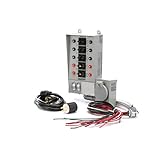
Manual transfer switch kit
Reliance Controls Pro/Tran 10-Circuit Transfer Switch Kit (31410CRK / 310CRK)
Best for: Portable generators up to 7,500 running watts with an L14-30 outlet

Generator power cord
WEN PC3025 30-Amp Generator Power Cord, 25 ft (L14-30P to L14-30R)
Best for: Connecting an L14-30 generator to a house inlet from 20 feet or more away
Jump to a section▾
Three legal methods, in ascending order of cost and capability. The illegal one, a double-ended cord into a receptacle, is covered in backfeeding dangers, and there is no version of it that's acceptable.
The three legal methods
| Method | How it works | Cost | Circuits reached |
|---|---|---|---|
| Interlock kit | Sliding plate makes main + generator breaker mutually exclusive | Lowest | Any circuit in the panel |
| Manual transfer switch | Separate sub-box wired to chosen circuits | Middle | Only the wired ones |
| Automatic transfer switch | Senses outage, starts and switches unattended | Highest | Whatever it feeds |
| – | – | Illegal and lethal |
With a portable generator, the interlock and the manual switch both connect through a generator inlet box outside; an automatic switch is normally paired with a hardwired standby unit. All three need a permit in most jurisdictions.
The last row is not a shortcut, it is the thing that kills people: a "suicide cord" back-feeds the utility transformer, which steps the voltage back up on the line a lineworker may be touching. It also leaves live exposed prongs at the cord end.
1. Extension cords: free, works today
Run properly sized outdoor-rated cords from the generator directly to the appliances you want powered.
Advantages: costs nothing beyond cords, needs no electrician, no permit, and nothing connects to house wiring so none of the backfeed hazards exist.
Limitations: only reaches cord-connected appliances. No furnace, no well pump, no sump pump, no hardwired anything. Cords run through a door or window, which is awkward in weather.
Do it properly:
- Outdoor-rated cords, sized for the length: undersized cords cause voltage drop that makes motors struggle to start. See generator extension cords and wire gauge.
- Never run cords through standing water.
- Don't daisy-chain cords to reach distance; use one long correctly-sized cord.
This is the honest starting point for anyone with a small portable generator, and it covers a refrigerator, some lights, and device charging, which is most of what a short outage requires.
2. Breaker interlock kit + inlet box: cheapest permanent option
A mechanical plate on the panel makes it physically impossible for the main breaker and the generator breaker to be on simultaneously. Paired with a power inlet box outside so the connecting cord has no exposed pins.
Advantages: least expensive permanent method, gives access to any circuit in the panel, and keeps your options open: you decide what to power each time.
Limitations: fully manual, and you manage load yourself by switching individual breakers. Requires a kit listed for your specific panel model and two adjacent free positions.
See generator interlock kit vs transfer switch.
3. Manual transfer switch: prioritization built in
A switch feeding a subpanel of selected circuits, typically 6 to 12. You choose at installation which circuits matter: furnace, refrigerator, well pump, sump pump, some lighting.
Advantages: prioritization is decided once and enforced automatically. Simple to operate, so anyone in the house can do it correctly.
Limitations: fixed circuit selection, higher cost than an interlock, still manual.
For a portable generator, one kit covers it: switch, outdoor inlet box and generator cord in one box:
We earn a commission if you buy through links on this page, at no extra cost to you. It does not change what we recommend. See our affiliate disclosure. As an Amazon Associate I earn from qualifying purchases.
The kit's cord is 10 ft, half the 20 feet CPSC asks between a generator and the house. A 25 ft L14-30 cord such as WEN's PC3025 (10 AWG, twist-lock at both ends, 30 A at 250 V) lets the generator park far enough out; the 40 ft PC3040 is the same cord for a deep yard or a corner.
4. Automatic transfer switch: for standby generators
Senses the outage, starts the generator, transfers automatically, and reverses when utility power returns.
Advantages: works when you're away or asleep. Usually pairs with load shedding so a smaller generator can serve a larger house.
Limitations: highest cost, requires a permanently installed standby generator with a fuel supply.
Essential if someone in the house depends on powered medical equipment. See manual vs automatic transfer switch.
What does every permanent method need?
A power inlet box. An exterior-mounted male inlet, so you connect with a proper cord and never handle exposed pins. Sized to the generator's output. See generator inlet box.
A permit and inspection. Standard in essentially every jurisdiction. See generator permits and inspection.
Correct neutral bonding. Whether the generator should be bonded or floating depends on whether the transfer equipment switches the neutral. Getting this wrong produces either no bond or two, both of which are defects. See generator neutral bonding.
The startup sequence
This matters more than people expect, and it's where most nuisance trips come from.
- Position the generator outdoors, well away from the house, exhaust pointed away. Never in a garage, even with the door open. See generator carbon monoxide safety.
- Turn off the loads you don't want: water heater, range, dryer, air conditioning.
- Start the generator with no load and let it stabilize for a minute or two.
- Connect the cord to the inlet box.
- Switch the main breaker off, then slide the interlock and switch the generator breaker on. (Or move the transfer switch.)
- Bring loads on one at a time: the largest motor first, while the generator is unloaded and has full surge capacity available. Smaller loads after.
- Watch the load if your generator has a meter.
Shutting down: reverse it. Loads off, generator breaker off, main back on, disconnect, then let the generator run briefly unloaded before stopping.
Sizing check first
None of this matters if the generator can't carry the load. Work out what you need before choosing a connection method. See what can a generator run, starting watts vs running watts, and the generator sizing calculator.
Standards and code reference
The standards behind this guide, for looking up in the edition your jurisdiction has adopted:
- NEC 702.5: transfer equipment preventing utility interconnection
- NEC Article 445: generator requirements
Code editions and local amendments vary. Confirm the adopted edition with your AHJ, and treat manufacturer instructions as governing wherever they are more restrictive.
Where to go next
More in our generator and backup power guides.
Frequently asked questions
Ask AI about this
Open an AI assistant with a question grounded in this page.