
Window AC Sizing Guide
Updated 2026-08-16 · 6 min read
Gear this guide recommends
We earn a commission if you buy through links on this page, at no extra cost to you. It does not change what we recommend. See our affiliate disclosure. As an Amazon Associate I earn from qualifying purchases.
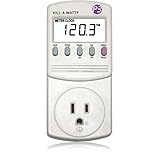
Plug-in power meter
P3 International Kill A Watt P4400
Best for: Measuring what one plug-in appliance really uses
Jump to a section▾
Window units are sized by BTU per hour. Getting it right matters more than people expect, because the failure mode of an oversized unit isn't wasted capacity; it's a cold, damp room.
Baseline by room size
| Room size | Baseline BTU |
|---|---|
| 100–150 sq ft | 5,000 |
| 150–250 sq ft | 6,000 |
| 250–350 sq ft | 7,000–8,000 |
| 350–450 sq ft | 10,000 |
| 450–550 sq ft | 12,000 |
| 550–700 sq ft | 14,000 |
| 700–1,000 sq ft | 18,000 |
Roughly 20 BTU per square foot. Now adjust.
The four adjustments
Sun exposure. A room with heavy afternoon sun, especially west-facing glass, takes a large solar gain. Add ~10%. A heavily shaded room: subtract ~10%.
Occupancy. The baseline assumes two people. Add ~600 BTU per additional regular occupant.
Kitchens. Cooking adds substantial heat. Add ~4,000 BTU if the unit serves a kitchen.
Ceiling height. The chart assumes about 8 feet. Higher ceilings mean more volume; scale up proportionally.
Also worth considering: top-floor rooms under a hot attic, and rooms with poor insulation, both run higher than the chart suggests.
Why is bigger wrong?
The instinct is to round up. Don't.
An air conditioner removes humidity by condensing moisture on a cold coil, and that takes time. An oversized unit drops the air temperature to setpoint quickly and shuts off before much moisture has been removed.
The result is a room that's cold and clammy: the thermostat is satisfied and it feels wrong. People respond by turning it down further, which makes it colder, still damp, and more expensive.
An appropriately sized (or slightly undersized) unit runs longer, keeps the coil cold, and pulls moisture out steadily. 76°F at 45% humidity is more comfortable than 72°F at 65%.
Oversized units also cycle more, which is noisier and harder on the compressor. See oversized HVAC problems.
Multiple rooms
Window units cool the space they can move air into. Air movement through a doorway is weak, and no amount of extra capacity fixes it.
- Open-plan area: one well-placed unit can work
- Separate rooms with doorways: generally won't, whatever the BTU rating
- A fan in the doorway helps somewhat, but not much
If you need several rooms cooled, that's several units, or a case for a mini split. See mini split vs window AC.
Electrical
Most window units up to about 12,000 BTU run on a standard 120-volt circuit. Larger units often need 240 volts and a dedicated circuit.
Two things to check:
- The plug configuration on the unit against your receptacle. A 240-volt unit needs a matching receptacle; see the NEMA plug chart.
- Circuit loading. A 12,000 BTU unit can draw 10–12 amps, most of a 15-amp circuit on its own. Running one on a bedroom circuit shared with other loads is a reliable way to trip a breaker. See how many outlets on a 20-amp circuit.
Efficiency: CEER
Window units are rated by CEER (Combined Energy Efficiency Ratio), which includes standby power. Higher is better.
Whether a higher-CEER unit pays back depends on runtime. A unit running most of the summer in a hot climate justifies the premium; one running a few weeks a year probably doesn't.
Estimate your running cost with the electricity cost calculator, and see cost to run an air conditioner.
Does an inverter window unit change the sizing?
It changes the penalty for getting it slightly wrong, which is the whole reason sizing is fussy in the first place.
A conventional window unit has one compressor speed: full. It reaches setpoint, shuts off, and waits, which is exactly the cycle that leaves a room cold and damp. A variable-speed (inverter) window unit modulates its compressor instead, running longer at lower output.
That does three useful things: it holds a steadier temperature, it keeps the coil cold long enough to actually dehumidify, and it's markedly quieter because it spends most of its time well below full speed.
You still size it the same way. But an inverter unit tolerates being a size large far better than a single-speed one does, because it can simply throttle down rather than short-cycle.
How much does a window AC cost to run?
The arithmetic is short, and it starts from the CEER rating:
Watts = BTU/h ÷ CEER
So an 8,000 BTU unit rated CEER 12 draws about 667 watts when the compressor is running.
From there, multiply by the hours it actually runs. A unit that's on for eight hours but cycling at roughly half duty is running about four compressor-hours:
- 667 W × 4 h = 2.7 kWh per day
- At $0.17/kWh (substitute your own rate) ≈ $0.45/day, or roughly $14 a month
Two things move that more than the CEER number does: how many hours it runs, and how well the install is sealed. A leaky side panel raises runtime on every hot day of the season. Run your own figures in the electricity cost calculator.
Which form factor should you buy?
"Window AC" now covers four genuinely different products:
| Type | How it mounts | Worth knowing |
|---|---|---|
| Standard window unit | Sits in the sash opening, window closes on top | Cheapest and most common; the sash stays open around the chassis |
| U-shaped (saddle) | Straddles the sill, window closes between the two halves | Much quieter: the compressor ends up outside a closed window; needs a window that opens wide enough |
| Through-the-wall | Permanent sleeve in the wall | Not interchangeable with a window unit: the chassis vents differently and needs its own sleeve |
| Portable (floor unit) | Stands on the floor, hose to the window | Most convenient, least efficient. A single-hose model exhausts room air outdoors, which pulls unconditioned outside air in through every leak in the house |
If noise is what you care about most, the U-shaped units are the meaningful upgrade. If you're replacing a unit in an existing wall sleeve, you need a through-the-wall chassis, not a window one.
What about a basement?
A basement is the case where the BTU chart misleads you. The cooling load is low (it's underground, shaded and cool), but the humidity load is high.
Size a window AC to that small sensible load and it will satisfy the thermostat in minutes, shut off, and never dry the air out. You get a cold, musty basement.
In most basements the right tool is a dehumidifier, not an air conditioner. Where you need both, an inverter unit that can run continuously at low output handles it far better than a single-speed one.
Installation points that affect performance
- Support the unit properly. They're heavy, and window frames aren't always designed for the load.
- Seal the gaps. The side panels that come with most units are thin and leaky. Foam and weatherstripping around them make a real difference: you're otherwise cooling the outdoors.
- Slight tilt outward so condensate drains outside rather than inside.
- Don't block the outdoor side. It needs to reject heat.
Where to go next
More in our heating and cooling guides.
Frequently asked questions
Ask AI about this
Open an AI assistant with a question grounded in this page.