
How Many Outlets Can Be on a 20-Amp Circuit?
Updated 2026-08-16 · 6 min read
Gear this guide recommends
We earn a commission if you buy through links on this page, at no extra cost to you. It does not change what we recommend. See our affiliate disclosure. As an Amazon Associate I earn from qualifying purchases.
Plug-in power meter
P3 International Kill A Watt P4400
Best for: Measuring what one plug-in appliance really uses
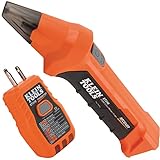
Circuit breaker finder
Klein Tools ET310
Best for: Labeling a panel without two people and a lot of shouting
Jump to a section▾
There is no number in the NEC limiting receptacles on a dwelling-unit general-purpose branch circuit. Electricians still use a rule of thumb, and both facts are worth understanding, because they answer different questions.
How many outlets can be on a 20 amp circuit?
10 receptacles on a 20-amp circuit. 8 on a 15-amp circuit.
The derivation: the NEC assigns 180 volt-amperes per general-use receptacle outlet for load-calculation purposes in non-dwelling occupancies. Apply the same figure informally to a residential circuit:
- 20 A × 120 V = 2,400 VA capacity
- 80% for continuous loading = 1,920 VA
- 1,920 ÷ 180 ≈ 10.7 → round down to 10
Same math on a 15-amp circuit: 1,440 ÷ 180 = 8.
It's a convention, not a code requirement for dwellings. It's also a good one, because it produces circuits that behave well in practice.
Does the NEC limit outlets per circuit?
Because outlet count is a poor proxy for load, and the NEC knows it.
Six outlets in a bedroom running two lamps and a phone charger draw perhaps half an amp. One outlet in that same bedroom running a 1,500-watt space heater draws 12.5 amps, most of a 15-amp circuit, from a single receptacle.
The receptacle itself draws nothing. Only what's plugged in matters, and the code can't know that in advance for a dwelling.
Instead, the NEC handles residential general lighting through a volt-amperes-per-square-foot calculation in Article 220, which sets the number of general-purpose circuits a home needs based on floor area rather than on outlet placement.
What is the 80% rule for circuits?
For a continuous load (three hours or more at maximum) the breaker may be loaded to no more than 80% of its rating:
| Circuit | Breaker | Continuous limit | Watts at 120 V |
|---|---|---|---|
| 15 A | 15 A | 12 A | ~1,440 W |
| 20 A | 20 A | 16 A | ~1,920 W |
This is the number that matters. A single space heater at 1,500 watts exceeds the continuous limit of a 15-amp circuit on its own. Two of them on a 20-amp circuit will trip it, whatever the outlet count.
Check real appliance draws in our appliance wattage chart or the how many amps does an appliance use pages.
Which circuits must be dedicated?
Outlet-count reasoning doesn't apply where the code requires a circuit to serve one thing:
- Kitchen small-appliance circuits: at least two 20-amp circuits serving the countertop receptacles, and these may not serve other rooms
- Laundry circuit: a 20-amp circuit for the laundry receptacles
- Bathroom receptacles: a 20-amp circuit serving bathroom receptacles
- Fixed appliances: dishwasher, disposal, microwave, furnace, and similar typically get their own circuits per the manufacturer's instructions
See dedicated circuit requirements for which appliances need their own.
How to plan a circuit properly
- List what will actually plug in, not how many outlets there are.
- Convert to amps: watts ÷ 120.
- Identify continuous loads: heating, EV charging, anything running for hours.
- Total it and compare against 12 A (15-amp circuit) or 16 A (20-amp circuit).
- Leave headroom. People plug in things you didn't plan for. A circuit at its limit on paper will trip in practice.
A worked example, a home office:
| Device | Watts | Amps |
|---|---|---|
| Desktop + monitors | 300 | 2.5 |
| Laser printer (peak) | 800 | 6.7 |
| Desk lamp | 10 | 0.1 |
| Phone/laptop chargers | 100 | 0.8 |
| Total | 1,210 | 10.1 |
Fine on a 20-amp circuit. Add a 1,500-watt space heater in January and you're at 22.6 amps, over the limit, and the breaker will say so.
Common mistakes
Counting outlets instead of loads. The most common error, and the reason a "code-compliant" circuit still trips.
Forgetting lights. In a dwelling, lighting and receptacles frequently share a circuit. Lighting counts toward the total.
Ignoring the 80% rule. A 20-amp circuit is not a 20-amp circuit for anything running continuously: it's 16.
Assuming a bigger breaker helps. It doesn't; the wire is the limit. See what size breaker do I need.
Overlooking a duplex receptacle counts as two. Under the 180 VA convention, each receptacle in the yoke counts, not each box.
When do you need to add a circuit?
If a circuit trips regularly with normal use, the answer is redistribution or a new circuit, not a bigger breaker. Whether adding a circuit is easy depends on free slots in your panel, which is a different question from having spare service capacity. See Electrical panel upgrade.
Code reference
The requirements behind this guide, for looking up in your adopted edition:
- NEC 220.14: general-use receptacle load, the basis for the volt-ampere method
- NEC 210.11: branch circuits required by occupancy
Code editions and local amendments vary by jurisdiction. Confirm the adopted edition with your AHJ before relying on any specific article.
Where to go next
- Why does my breaker keep tripping
- Dedicated circuit requirements
- Home electrical load calculator
- 20 amp outlet: when you actually need one
More in our electrical panel guides.
Frequently asked questions
Ask AI about this
Open an AI assistant with a question grounded in this page.