
Can a Power Station Run a Refrigerator?
Updated 2026-08-15 · 7 min read
Gear this guide recommends
We earn a commission if you buy through links on this page, at no extra cost to you. It does not change what we recommend. See our affiliate disclosure. As an Amazon Associate I earn from qualifying purchases.
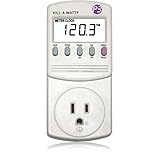
Plug-in power meter
P3 International Kill A Watt P4400
Best for: Measuring what one plug-in appliance really uses

1 kWh class
Jackery Explorer 1000 v2
Best for: First power station: fridge, phones, lights and CPAP through an outage
Jump to a section▾
Yes, usually, and the runtime is better than the numbers suggest. But one specification decides whether it works at all.
Surge is the gate
A refrigerator's compressor is an induction motor. At the instant it starts, it draws far more than its running power:
| Typical | |
|---|---|
| Running watts | 150–250 W |
| Starting surge | 800–1,200 W |
So a station rated 500 W continuous with a 1,000 W surge might start a modern efficient fridge and fail on an older one. The continuous rating is not the problem; the surge is.
Check both specifications against the fridge's nameplate, and be conservative if it's close. Surge ratings vary in honesty between manufacturers, and a marginal start is hard on the compressor as well as the inverter.
Modern inverter-compressor refrigerators surge far less: they ramp up rather than starting hard. If yours is recent, the requirement may be much lower than the table suggests.
See starting watts vs running watts.
Duty cycle makes runtime good
The pleasant surprise.
A refrigerator doesn't run continuously; it cycles, commonly on the order of a third of the time in normal conditions. So average consumption is far below running watts:
200 W running × ⅓ duty cycle ≈ 65 W average
Which means a 1,000 Wh station covers roughly 12 to 15 hours of normal fridge operation, allowing for inverter losses.
What shortens it:
- A hot room. The compressor works harder and cycles more.
- Frequent door openings. Each one admits warm, humid air.
- A nearly empty fridge, which has less thermal mass.
- A separate freezer on the same station.
How do you find your fridge's real numbers?
The ranges above are typical. Yours is a specific appliance, and finding its actual figures takes very little effort.
The nameplate (usually inside the door, on a side wall, or on the back) gives the running current in amps. Multiply by 120 for approximate running watts: a fridge marked 1.8 A is drawing around 215 W while the compressor runs. Some nameplates also print LRA (locked rotor amps), which is the starting draw; multiply that by 120 for the surge requirement, and it's the number that decides everything.
A plug-in energy monitor is better still, and it's the measurement worth making before you buy anything. Leave one between the fridge and the wall for 24 hours and it reports the actual kilowatt-hours consumed. That single number is your real daily requirement:
- A fridge measuring 1.5 kWh/day needs about 1,500 Wh of usable battery to cover a full day
- Divide by 0.85 for inverter losses → roughly 1,750 Wh rated capacity
That's a far more honest input than any table, it accounts for your kitchen's temperature and your household's door-opening habits, and the monitor costs less than a bad guess.
We earn a commission if you buy through links on this page, at no extra cost to you. It does not change what we recommend. See our affiliate disclosure. As an Amazon Associate I earn from qualifying purchases.
Does the inverter's waveform matter?
Yes, for a refrigerator specifically.
Reputable power stations output a pure sine wave, which is what a compressor motor is designed for. Cheaper inverters (particularly older automotive ones) produce a modified sine wave, a stepped approximation that makes induction motors run hotter and less efficiently, and that some electronic controls simply reject.
A modern refrigerator with an inverter compressor and a control board is exactly the appliance most likely to object. If a spec sheet doesn't say "pure sine wave", assume it isn't one.
If your station's surge is marginal, there's one more option worth knowing: a hard start kit. It adds a start capacitor and relay to the compressor circuit, increasing starting torque and shortening the inrush. It's a common fix for running a fridge or air conditioner off a generator or inverter that's otherwise just short. It must be matched to the compressor, so this is a job for an appliance technician rather than a guess, but it can rescue a pairing that's close.
How long does food actually stay safe?
Worth knowing precisely, because it's what the whole exercise is protecting.
The target temperatures are 40°F or below for the refrigerator and 0°F for the freezer. Federal food-safety guidance for a power outage is straightforward:
| Compartment | Safe for, if kept closed |
|---|---|
| Refrigerator | About 4 hours |
| Freezer, full | About 48 hours |
| Freezer, half full | About 24 hours |
Note that every one of those figures assumes the door stays shut. That's why "keep the doors closed" is the first item in the list below rather than an afterthought: it's worth more than a second battery.
Two habits make the aftermath much easier:
- Keep an appliance thermometer in each compartment. After an outage you can read the temperature instead of guessing, and guessing is how people either throw out good food or keep unsafe food.
- Freeze a cup of water solid and put a coin on top of the ice. If you come home and the coin is at the bottom, the freezer thawed and refroze while you were away. If it's still on top, it didn't.
Food that has stayed at or below 40°F is generally fine. Food above that for more than about two hours is not, and no amount of "it smells alright" changes that.
The trick that stretches capacity
You don't need to run it continuously.
A full, closed refrigerator holds safe temperature for several hours on its own. A full freezer holds considerably longer, commonly cited as around 48 hours if left shut.
So with limited battery capacity:
- Keep the doors shut. This single habit does more than anything else.
- Run the fridge in bursts (a few hours on, a few hours off) rather than continuously.
- Fill empty space with water bottles or jugs. Thermal mass holds cold, and frozen bottles act as ice blocks.
- Move critical items to the freezer, which stays cold longer.
This effectively doubles or triples what a given battery capacity achieves.
Sizing summary
| Station | Realistic fridge coverage |
|---|---|
| 500 Wh | A few hours, if the surge clears |
| 1,000 Wh | Roughly 12–15 hours |
| 2,000 Wh | A day or more |
| 2,000 Wh + solar | Indefinite in good sun |
Add solar recharging and a multi-day outage becomes manageable. See solar generator charging.
Practical setup
Plug the fridge directly into the station, not through a long extension cord. Voltage drop over an undersized cord makes a marginal start fail.
Watch for the compressor start the first time. If the station's protection trips, the surge rating isn't sufficient and no amount of battery capacity fixes it.
Some stations offer UPS pass-through, keeping the fridge on grid power and switching to battery instantly on failure. Convenient: nothing to plug in when the outage starts.
Turn off the ice maker. It cycles the compressor more and adds a heater in some models.
Freezers
Broadly similar surge behavior, slightly lower running power, and much better thermal inertia.
A chest freezer in particular holds cold remarkably well because cold air doesn't spill out when the lid opens. If you're prioritizing, a full chest freezer often needs less backup attention than the fridge.
When is a generator the better answer?
If the outage runs days rather than hours, a power station alone runs out. Options:
- Solar panels to recharge it
- A generator to recharge it periodically: quiet nights on battery, a couple of noisy hours a day for recharging
- A generator running the fridge directly, with the station reserved for electronics
See battery backup vs generator.
A unit that does this comfortably
The math above says ~1 kWh of capacity and 1,200 W+ of surge headroom. The reference unit in that class:
We earn a commission if you buy through links on this page, at no extra cost to you. It does not change what we recommend. See our affiliate disclosure. As an Amazon Associate I earn from qualifying purchases.
1 kWh class
Jackery Explorer 1000 v2
The default 1 kWh station: LiFePO4, 1500 W inverter, and the brand with the longest consumer track record in the category.
Best for: First power station: fridge, phones, lights and CPAP through an outage
- Capacity
- 1,070 Wh LiFePO4
- Cycle life
- 4,000 cycles to 70%+
- AC output
- 1,500 W continuous / 3,000 W surge
- USB
- USB-C 100 W + 30 W, USB-A
- Solar input
- 400 W max
- Recharge (AC)
- 1.58 hr; 1 hr emergency mode
- UPS switchover
- <20 ms
- Weight
- 23.8 lb
- Warranty
- 3 + 2 years
- 1,500 W inverter runs a refrigerator, sump pump or microwave, the loads that matter in an outage
- LiFePO4 chemistry rated for 4,000 cycles; this is a decade-class battery
- Light enough to carry one-handed
- Not expandable: 1 kWh is what you get
- 400 W solar ceiling means a full solar recharge takes most of a sunny day
More options in every size are in the power station picks.
Where to go next
- How to size a portable power station
- Portable power stations explained
- Solar generator charging
- Size it properly: generator sizing calculator
More in our generator and backup power guides.
Frequently asked questions
Ask AI about this
Open an AI assistant with a question grounded in this page.