
How to Find Which Breaker Controls an Outlet
Updated 2026-09-13 · 8 min read
Gear this guide recommends
We earn a commission if you buy through links on this page, at no extra cost to you. It does not change what we recommend. See our affiliate disclosure. As an Amazon Associate I earn from qualifying purchases.
Circuit breaker finder
Klein Tools ET310
Best for: Labeling a panel without two people and a lot of shouting
Jump to a section▾
Tracing an outlet to its breaker is a common need: you're replacing a receptacle, hanging a fixture, or troubleshooting. There are three ways to do it, and they differ mainly in how much walking is involved.
How do I find which breaker controls an outlet?
| Method | Speed | Needs |
|---|---|---|
| Circuit tracer / breaker finder | Minutes | A tracer (~$40–$150) |
| Plug-in radio or lamp | Moderate | A helper, or a loud radio |
| Phone on speaker, on a call | Moderate | Nothing extra |
| Read the directory | Instant | A directory that's actually accurate |
| Turn off everything, restore one at a time | Slow | Patience, and a plan for clocks |
If you are doing this more than once, a circuit tracer pays for itself immediately, and the real fix is to label the panel properly the first time you work it out, so nobody repeats the exercise.
What should you do before mapping circuits?
Check the directory. Inside the panel door there may already be a card. If it's accurate, you're done. If it says "bedroom" three times, you're not, and the exercise below is also how you fix that, permanently. See how to label an electrical panel.
Confirm the outlet is live. A non-contact voltage tester or a plug-in tester tells you in a second. Tracing a dead outlet by turning off breakers gets confusing quickly.
Shut down computers. You're about to cut power repeatedly.
Method 1: the radio
Free, needs no tools, works alone.
- Plug a loud radio into the outlet and turn the volume up.
- Go to the panel and turn breakers off one at a time.
- When the music stops, that's your breaker.
- Turn it back on and confirm the radio returns.
Best for: one outlet, when you have a radio. Slow if the panel is far from the outlet, since you may be walking back and forth.
Method 2: a plug-in outlet tester with an alarm
Free-ish (the tester is inexpensive) and faster than the radio for a whole house.
A three-light receptacle tester also tells you whether the outlet is wired correctly (open ground, reversed polarity, open neutral) which is a useful bonus while you're already at every outlet.
Same procedure as the radio, but the tester also gives you a wiring check at each stop.
Method 3: a breaker finder
A transmitter that plugs into the outlet and a receiver you sweep across the breakers. The receiver signals which breaker carries the transmitter's signal.
This is the method that scales. Mapping a 30-circuit house with a radio is an afternoon; with a finder it's about an hour, with no walking between the panel and the outlet.
Two practical notes:
- Adjacent breakers may both respond. Turn the sensitivity down and re-sweep to isolate.
- Many finders include a receptacle tester in the transmitter, so the tool does both jobs.
We cover the options in the best electrical testers roundup.
We earn a commission if you buy through links on this page, at no extra cost to you. It does not change what we recommend. See our affiliate disclosure. As an Amazon Associate I earn from qualifying purchases.
Method 4: two people and a phone
The classic. One person at the panel, one at the outlet, phones on speaker. Faster than walking, and free.
How do you trace a light or a hardwired appliance?
Everything above assumes there's a receptacle to plug something into. Often there isn't.
- Ceiling and wall lights. Easiest case: the light is the indicator. Switch it on and work through the breakers. The only trap is a fixture on a smart switch or dimmer that takes a moment to respond.
- Hardwired appliances (dishwasher, disposal, range hood, hardwired heater). Run the appliance and listen. A dishwasher on a rinse cycle is an excellent indicator that carries through a whole house.
- The furnace, water heater or AC. Don't cycle these repeatedly to find a breaker. They're on dedicated circuits, they're labelled at the equipment more often than not, and short-cycling a compressor is genuinely bad for it.
- Anything else. Most circuit tracers come with alligator or clamp leads so the transmitter can be attached directly to a de-energized conductor rather than plugged in. That's the answer for a junction box, a light with no switch access, or a circuit you've already opened up.
One note on AFCI and GFCI breakers: tracers inject a signal onto the circuit, and the electronics in these breakers can make the receiver reading less crisp. Turn the sensitivity down and confirm the result the old-fashioned way before you rely on it.
How do you map the whole house in one pass?
The efficient order is not the intuitive one. Don't turn everything off and restore one at a time: you'll fight clocks, the furnace and the freezer for an afternoon.
Instead:
- Leave everything on. Number a piece of painter's tape for every breaker and stick it beside the panel.
- Turn off breaker 1 only.
- Walk the house with a plug-in tester or a lamp, checking every receptacle, switch and fixture. Note everything that went dead.
- Turn breaker 1 back on, turn off breaker 2, repeat.
You touch each breaker twice and walk the house once per circuit, but you can move fast, because you're only looking for what changed. A tracer collapses this further, since you work from the outlet end instead.
Two things worth recording as you go, beyond which breaker: whether the receptacle is GFCI-protected, and whether the tester shows a wiring fault. You're already standing at every outlet in the house; it's the cheapest audit you'll ever do.
What should the finished directory actually say?
There's a code standard for this, and it's stricter than most homeowners assume.
NEC 408.4(A) requires every circuit to be legibly identified as to its clear, evident and specific purpose, with enough detail to distinguish it from every other circuit. It also says the identification can't rely on transient occupancy: "Jake's room" fails, because Jake moves out.
So not this:
- Lights · Bedroom · Outlets · Misc · Spare
But this:
- Kitchen counter receptacles, north wall
- Dishwasher
- Bedrooms 2 & 3 receptacles, second floor
- Furnace and condensate pump
NEC 408.4(B) adds a second requirement people rarely meet: a panel fed by a feeder must be marked to show where its supply originates. If you have a subpanel, it should say which breaker in which panel feeds it. Write it on both ends while you're at it.
What surprises people when they map a house?
Consistently, the same few things, and none of them are faults:
- Rooms don't map to circuits. Circuits were run for wiring convenience, not by room. One circuit commonly serves half of two adjacent rooms.
- A single circuit crosses floors. Especially in stacked layouts where the wiring followed a stud bay.
- The outdoor receptacle is fed from the garage GFCI, or the basement one, which is why it's dead and no breaker is tripped.
- The bathroom receptacles are all on one circuit, across several bathrooms, protected by a single GFCI in one of them.
- A "spare" breaker isn't spare. It feeds something disconnected, or something you haven't found yet. Label it as unknown rather than spare.
None of these need fixing. All of them are worth writing down, because they're exactly what you'll want to know at 11pm during the next problem.
When it doesn't work
No breaker kills the outlet.
- Was it live to begin with? Confirm with a tester.
- Is it downstream of a GFCI? A tripped GFCI receptacle elsewhere kills everything downstream. Look in bathrooms, garage, outdoors, basement. See why does my GFCI keep tripping.
- Is there a subpanel? Garages, additions, and finished basements are often fed from a second panel. Check there. See what is a subpanel.
- Still live with the main off? Stop. That means the outlet is fed from a source other than your panel: a generator interlock, a second service, or a neighboring unit's circuit in a multi-family building. This needs an electrician.
Two breakers seem to affect the same outlet. Possibly a multi-wire branch circuit sharing a neutral, which should have handle-tied breakers. Note it and mention it to an electrician. See single-pole vs double-pole breakers.
Only half the outlet dies. A switched receptacle. Note it on the directory.
While you're doing it, do it once
If you're already tracing one outlet, tracing the rest costs marginal time and produces a permanent asset: an accurate circuit directory. It's the highest-value hour you can spend on your electrical system, and it means you never do this again.
Photograph the finished directory and keep it on your phone.
The tool that collapses Method 3
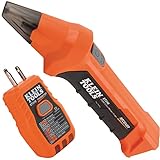
Method 3 is the one that turns an afternoon into an hour, and it needs a transmitter-and-receiver pair rather than a radio. This is the reference unit in that class, and its transmitter doubles as the three-light receptacle tester Method 2 relies on, so one tool covers the wiring check at every outlet as well.
Circuit breaker finder
Klein Tools ET310
Transmitter-and-receiver pair that maps an outlet to its breaker, with a receptacle tester built into the transmitter.
Best for: Labeling a panel without two people and a lot of shouting
- Method
- Plug-in transmitter + handheld receiver
- Extras
- Built-in GFCI receptacle tester
- Operation
- Auto-learning: scan the panel once to learn it, then again to find the breaker
- Voltage
- 90–120 V AC circuits only
- Turns panel labeling from an afternoon into an hour
- Doubles as a receptacle tester, so it replaces a tool rather than adding one
- 120 V circuits only: it won't trace a 240 V breaker
- Tight, densely packed panels still take patience: follow the learn-then-scan sequence exactly
How the testers compare
Each method above leans on a different class of tool: the plug-in receptacle tester for Method 2, the transmitter-and-receiver pair for Method 3, and a non-contact voltage tester to confirm an outlet is live before you start. The clamp meters and multimeters at the bottom of the table are for the work that comes after: measuring what a circuit actually draws once you know which breaker feeds it.
| Product | Type | Best for | Safety rating |
|---|---|---|---|
| Klein Tools NCVT-3P | Non-contact voltage tester | Confirming a circuit is dead before you open a device or box | CAT IV 1000 V |
| Fluke 1AC-A1-II VoltAlert | Non-contact voltage tester | A simple, rugged live/dead check on 120 V and 240 V branch circuits | CAT IV 1000 V |
| Sperry Instruments GFI6302 | Receptacle tester | Checking every outlet in a house quickly for miswiring | – |
| Klein Tools RT250 | Receptacle tester | Diagnosing voltage drop or a flaky circuit, not just wiring order | – |
| Klein Tools ET310 | Circuit breaker finder | Labeling a panel without two people and a lot of shouting | – |
| Fluke 117 | Multimeter | Anyone who will do this more than once a year | CAT III 600 V |
| Fluke 323 | Clamp meter | Measuring what a hardwired circuit actually draws, even in a crowded panel | CAT IV 300 V / CAT III 600 V |
The full write-up of each is in the electrical tester picks.
Where to go next
- How to label an electrical panel
- How to read your electrical panel
- Best electrical testers
- Appliance wattage chart
More in our electrical panel guides.
Frequently asked questions
Ask AI about this
Open an AI assistant with a question grounded in this page.