
Volts to Amps Calculator
Convert volts to amps. Voltage alone never gives you current, so this converter asks what else you know (resistance in ohms, or power in watts), and solves with the right formula. It then shows the NEC breaker and copper wire size the resulting current calls for.
Voltage on its own does not determine current: the load does. Ohm's law mode suits a fixed resistance (a heating element, a test resistor); power mode suits a nameplate rating in watts. Resistance mode assumes a purely resistive load, so its watts figure is V × I.
Current
12 A
- Voltage
- 120 V
- Resistance
- 10 Ω
- Power dissipated
- 1,440 W
NEC wire & breaker for this load
- Breaker
- 15 A
- Min. copper wire (75°C)
- 14 AWG
Copper, 75°C terminations, NEC Table 310.16. Real installs may need derating for ambient heat, conduit fill, or voltage drop. Full wire & breaker chart. Always confirm with a licensed electrician + local AHJ.
Measure the real amps and volts
The converter works from nameplate or assumed figures. A clamp meter reads the actual current on one conductor without breaking the circuit; clamped around a whole cord it reads close to zero. A multimeter reads the voltage at the receptacle or terminals. Opening a panel or a live box is work for someone qualified.
We earn a commission if you buy through links on this page, at no extra cost to you. It does not change what we recommend. See our affiliate disclosure. As an Amazon Associate I earn from qualifying purchases.
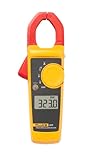
Clamp meter
Fluke 323
Best for: Measuring what a hardwired circuit actually draws, even in a crowded panel

Multimeter
Fluke 117
Best for: Anyone who will do this more than once a year
Frequently asked questions
Ask AI about this
Open an AI assistant with a question grounded in this page.
Related tools
Related converters
Watts ↔ Amps
Convert watts to amps (or amps to watts) for DC, single-phase, and three-phase, plus the NEC wire and breaker the result needs.
Open converterkW ↔ Amps
Convert kilowatts to amps (or amps to kW) for DC, single-phase, and three-phase circuits, with the matching NEC wire and breaker size.
Open converterVolts ↔ Watts
Convert volts to watts (or watts to volts) using the current (watts = volts × amps) for DC, single-phase, and three-phase, with the NEC wire and breaker.
Open converterWatts ↔ kW
Convert watts to kilowatts and back. 1 kW = 1,000 W. Enter watts or kilowatts to see the other instantly.
Open converterCite or link to this pageAPA · MLA · Chicago · HTML
Free to cite, quote and link. Copy a ready-made citation: the link back is all we ask.
- APA
WattSimple. (2026, July 19). Volts to Amps Calculator. https://wattsimple.com/convert/volts-to-amps
- MLA
"Volts to Amps Calculator." WattSimple, 19 July 2026, https://wattsimple.com/convert/volts-to-amps.
- Chicago
WattSimple. "Volts to Amps Calculator." Last modified July 19, 2026. https://wattsimple.com/convert/volts-to-amps.
- HTML link
<a href="https://wattsimple.com/convert/volts-to-amps">Volts to Amps Calculator</a> (WattSimple)
Sources & standards
This tool's methodology and data follow US standards and authoritative public datasets: