
Smart Electrical Panels Explained
Updated 2026-08-16 · 6 min read
Gear this guide recommends
We earn a commission if you buy through links on this page, at no extra cost to you. It does not change what we recommend. See our affiliate disclosure. As an Amazon Associate I earn from qualifying purchases.
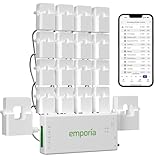
Whole-home energy monitor
Emporia Vue 3 Home Energy Monitor (16 circuit sensors)
Best for: Measuring hardwired and 240 V loads, or every circuit at once
Jump to a section▾
A smart panel is a normal load center with three additions: it measures each circuit, it can switch circuits remotely, and it runs software that decides what to shed when. That last capability is the reason it's relevant to electrification.
What does a smart electrical panel do?
Per-circuit monitoring. Energy use by circuit rather than one whole-house number. Useful for finding what's actually consuming, and for verifying that a new heat pump performs as expected.
Remote breaker control. Circuits can be switched from an app. Convenience, but also the mechanism behind load management.
Load management. The important one. The panel can prioritize circuits and shed lower-priority loads when total demand approaches a limit, which can let a home run more electric appliances than a static load calculation would otherwise permit.
Backup integration. Many smart panels are designed to work with home batteries and solar, managing which circuits stay energized during an outage and in what priority order.
Outage awareness. Notifications when power drops, which matters if you have a freezer, a sump pump or medical equipment.
Why do smart panels matter for electrification?
The constraint in most electrification projects is calculated load. The NEC calculation assumes coincident operation of loads that rarely coincide, a worst case, by design.
Load management makes non-coincidence enforced rather than hoped for. When a listed energy management system limits a load, it can be counted at its controlled maximum rather than its nameplate rating.
That's what allows a home with an EV charger, a heat pump, a heat pump water heater and an induction range to fit a service that a static calculation says is full.
Whether it applies to your case depends on the specific product's listing and your AHJ's acceptance. Your adopted code edition governs. Confirm before relying on it. See load management for home electrification.
Do you need a smart panel or just a load manager?
You don't need a smart panel to get load management. Alternatives:
| Approach | What it does | Consider when |
|---|---|---|
| Smart panel | Whole-panel monitoring, control, management | Panel needs replacing anyway; battery/solar integration |
| Standalone energy management device | Monitors the service, controls specific loads | Existing panel is fine |
| Appliance-level management | Charger or water heater self-throttles | Only one or two large loads |
| Listed circuit-sharing device | Two appliances share one circuit | A specific appliance pair |
If your existing panel is in good condition and you only need to manage an EV charger, a standalone or appliance-level solution is far less expensive. A smart panel makes sense when you're replacing the panel anyway: at that point the incremental cost is the difference between panel types, not the full price.
See circuit sharing devices explained and electrifying without a panel upgrade.
What should you ask before buying a smart panel?
What happens offline? The single most important question. Core overcurrent protection is in the breakers and doesn't depend on connectivity, but scheduling, remote control and some management features may. Ask specifically what still works with no internet and no cloud service.
Is the load management capability listed for the purpose, and will your AHJ accept it in the load calculation? This is what determines whether it solves your capacity problem.
Are the breakers proprietary? Most smart panels use their own breakers. That affects future availability and cost, worth knowing for a device with a multi-decade lifespan.
What's the company's track record? A panel is a 30-plus year installation. Software-dependent hardware from a young company carries a real long-term risk.
Is there a subscription? Some features may require ongoing service.
Does it integrate with what you have or plan? Solar inverter, home battery, EV charger: if integration is part of the appeal, verify it for your specific equipment.
When is a smart panel worth it?
Strong case:
- Your panel needs replacing anyway, and you need load management
- You're installing or planning solar plus battery backup, where circuit prioritization is genuinely valuable
- You're electrifying comprehensively on a constrained service
- You want per-circuit visibility and will actually use it
Weak case:
- Your service has ample headroom and you just want monitoring: a whole-home energy monitor costs far less
- Your panel is fine and only one load needs managing
- You're not comfortable with software-dependent infrastructure
If monitoring is all you're after, a clamp-on whole-home monitor installs in the existing panel and reports per-circuit use from an app:
We earn a commission if you buy through links on this page, at no extra cost to you. It does not change what we recommend. See our affiliate disclosure. As an Amazon Associate I earn from qualifying purchases.
The backup power angle
Where smart panels are least contested is backup.
During an outage, a battery or generator can only supply so much. Something has to decide which circuits stay energized, traditionally a separate essential-loads subpanel with circuits physically moved into it.
A smart panel does this in software, and can change priorities dynamically as available energy declines. That's a genuine capability improvement over a static subpanel, and it avoids the rewiring.
See do you need a home battery, using an EV as home backup power, and bidirectional charger requirements.
Practical notes
- Installation is a panel replacement: permitted, inspected work by a licensed electrician. See permits for home electrification.
- It doesn't add service capacity. It manages what you have. If your service conductors are genuinely undersized, that's a different project.
- Working clearance rules still apply: see electrical panel working clearance requirements.
- Keep the panel schedule documented regardless of what the app shows.
The bottom line
Smart panels add per-circuit monitoring, remote control and, the part that matters, load management that can let a constrained service support full electrification. They're worth the premium when you're replacing the panel anyway, when battery backup is in the picture, or when load management is what unlocks your project. Ask what works offline, whether the breakers are proprietary, and whether your AHJ accepts the management capability in the load calculation.
Check your capacity with the home electrical load calculator, model usage with the electricity cost calculator, or read load management for home electrification.
Standards and code reference
The standards behind this guide, for looking up in the edition your jurisdiction has adopted:
- NEC 750: energy management systems
- UL 67 / UL 869A: panelboard and service equipment standards
Code editions and local amendments vary. Confirm the adopted edition with your AHJ, and treat manufacturer instructions as governing wherever they are more restrictive.
Frequently asked questions
Ask AI about this
Open an AI assistant with a question grounded in this page.