
EV Charger Cable Length: How Long Do You Need?
Updated 2026-10-10 · 6 min read
Gear this guide recommends
We earn a commission if you buy through links on this page, at no extra cost to you. It does not change what we recommend. See our affiliate disclosure. As an Amazon Associate I earn from qualifying purchases.
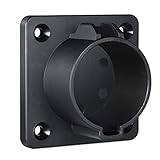
Cable management
Lectron J1772 Nozzle Holster Dock
Best for: Finishing any charger install properly
Jump to a section▾
Cable length is the most common regret after a home charger install, and it's entirely avoidable. The mistake is measuring the straight line from the wall to the car instead of the path the cable actually has to travel.
Choosing a cable length
| Cable | Reaches | Best for |
|---|---|---|
| 16 ft | The adjacent bay, port on the near side | Charger mounted right at the parking spot |
| 20 ft | Across one bay comfortably | The common default |
| 25 ft | Either bay in a two-car garage | Two EVs, or an uncertain port position |
| Over 25 ft | Awkward parking, outdoor runs | Heavy to handle; needs a management hook |
Measure the routed path (down the wall, along the floor, around the car), not the straight-line distance. And measure with the car parked the way it actually parks, in both orientations if you sometimes back in. A cable that is 2 ft short is unusable; one that is 5 ft long is merely untidy.
Why port location makes this hard
Charge ports are not standardized. Across current EVs you'll find them on:
- The rear quarter panel, driver's side
- The rear quarter panel, passenger's side
- The front fender, driver's side
- The front fender, passenger's side
- The nose, front and center
Which means the "right" cable length depends on your specific vehicle and which way you park and where the charger is mounted. Change any one of those and the requirement changes. The EV model reference is a good place to confirm your vehicle's layout before you buy.
How to measure properly
Do this with the car parked exactly where it normally sits:
- Mark the charger location on the wall: the actual mounting point, at the actual height.
- Run a string or tape from that point down to the floor, along the path the cable would drop and lie.
- Route it around the vehicle to the charge port, not through the car, not diagonally over the hood.
- Add slack for the connector reach and a comfortable bend into the port, plus enough that the cable isn't under tension.
- Repeat for the other parking direction if you sometimes back in.
- Repeat for the second parking spot if a second EV is plausible.
Take the longest result and add margin. That's your minimum.
The cases that need extra length
Two-car garages. If one charger has to serve both bays, the cable must reach the far bay's port with the car in either orientation. This is the single biggest driver of long-cable purchases. If it's a stretch, consider two chargers on a shared circuit instead; see charging two EVs at home.
Charger on the wrong wall. Panels are often on the opposite side of the garage from where you park. Relocating the charger costs conduit and labor; a longer cable costs nothing at purchase time. EV charger conduit and wire runs covers the tradeoff between moving the charger and buying cable.
Driveway and outdoor installs. Outdoor parking positions are less precise than a garage bay, and you may park differently in winter. Add margin. See outdoor EV charger installation.
Trailers and roof boxes. If you tow, the car sits further forward and the port may be further from the wall than usual.
Guests and future vehicles. A longer cable makes your charger useful to any EV that visits, regardless of port location.
Why isn't longer automatically better?
Long cables have real costs:
- Weight. High-amperage EVSE cable is heavy. A long one is a genuine daily nuisance for some users.
- Cold stiffness. Cable jackets stiffen in the cold, and a long stiff cable is hard to coil and hard to hang. Cold-climate buyers should weigh this seriously; see cold-weather EV charging.
- Storage. A cable that won't hang neatly ends up on the floor, where it gets driven over and stepped on.
- Wear. More cable dragged across concrete means more jacket abrasion over a decade.
The rule of thumb: buy the length you need plus reasonable margin, not the longest available.
Cable management is part of the decision
A charger with a well-designed holster and integrated hook will handle a long cable far better than one without. When comparing models, look at:
- Whether the connector holster holds the handle securely
- Whether there's a cable hook or wrap integrated into the unit
- Whether a wall-mounted cable hanger is available separately
A separate wall hook mounted a few feet from the charger turns an unmanageable long cable into a tidy one. It's inexpensive and worth installing at the same time.
Can I use an extension cord for EV charging?
Never use an extension cord. EVSE cable is engineered for continuous high current with a specific conductor size and connector rating. An extension cord introduces resistance, heat, and a connection point that isn't designed for it. Manufacturers prohibit it, and it's a genuine fire risk. The code limits, the voltage-drop numbers and the fixes that work are in EV charger extension cord.
Don't stretch the cable to reach. A cable under tension puts strain on both the connector and the charger's strain relief, the exact places cables fail.
Don't run the cable across a walkway where it becomes a trip hazard, or across a garage door path where it can be crushed.
If the cable doesn't reach, the answer is a longer cable or a relocated charger, not a workaround.
Cable length in the buying decision
Slot this into your overall selection process (choosing a Level 2 EV charger) after amperage and before smart features. Also check whether the manufacturer's warranty covers the cable: cables fail more often than electronics, and coverage varies. EV charger brands compared covers what else differs between manufacturers.
If your cable is already damaged or showing wear, see charging cable damage and safety.
While you're at it
Whatever the cable length, the connector shouldn't live on the floor: a dock costs less than any repair it prevents:
We earn a commission if you buy through links on this page, at no extra cost to you. It does not change what we recommend. See our affiliate disclosure. As an Amazon Associate I earn from qualifying purchases.
Cable management
Lectron J1772 Nozzle Holster Dock
A wall dock the J1772 connector clicks into, keeping the nozzle off the floor and the cable coiled.
Best for: Finishing any charger install properly
- Fits
- All J1772 connectors (NACS version sold separately)
- Material
- High-quality plastic
- Mounting
- Screws + plugs included, indoor/outdoor
- Ends the connector-on-the-floor habit that kills charge ports and connectors
- Costs less than any repair it prevents
- Plastic body; the NACS version is sold separately
The bottom line
Measure the real routed path from your actual mounting point, around the actual car, to the actual port, in both parking directions, then add margin. Buy that length, not the longest on the shelf. Add a wall hook for management, and never solve a short cable with an extension cord.
Estimate the full install with the home charger install cost calculator, or size the circuit with the Level 2 charger breaker size calculator.
Frequently asked questions
Ask AI about this
Open an AI assistant with a question grounded in this page.