
How to Do a Home Electrical Load Calculation
Updated 2026-08-16 · 8 min read
Gear this guide recommends
We earn a commission if you buy through links on this page, at no extra cost to you. It does not change what we recommend. See our affiliate disclosure. As an Amazon Associate I earn from qualifying purchases.
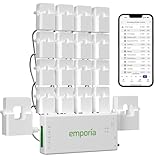
Whole-home energy monitor
Emporia Vue 3 Home Energy Monitor (16 circuit sensors)
Best for: Measuring hardwired and 240 V loads, or every circuit at once
Jump to a section▾
The load calculation is the single most useful thing you can do before any electrical project. It's the difference between "you'll need a service upgrade" being a fact and being a sales pitch.
The NEC gives two methods for dwellings. This walks through the optional method (Article 220, Part IV), which is simpler and usually more favorable: it's what most electricians run for a service upgrade.
Why can you not just add up appliance amps?
Add every nameplate in a typical house and you'll get 40 kVA or more. Divide by 240 volts and that's 170 amps, apparently requiring a 200-amp service for a modest home.
But your range, dryer, water heater, and heat pump have never all run at full output in the same minute. The NEC models this with demand factors: standardized reductions reflecting real diversity.
Get this wrong in the conservative direction and you buy a service upgrade you didn't need.
Step 1: General lighting and receptacle load
3 volt-amperes per square foot of habitable floor area. Exclude open porches, garages, and unfinished spaces not adaptable for future use.
2,000 sq ft × 3 VA = 6,000 VA
Step 2: Small-appliance and laundry circuits
1,500 VA for each required circuit:
- Two small-appliance branch circuits minimum for the kitchen (more if the home has them)
- One laundry circuit
2 × 1,500 + 1 × 1,500 = 4,500 VA
Step 3: Fixed appliance loads
Add the nameplate rating of every fastened-in-place appliance. Common ones:
| Appliance | Typical nameplate |
|---|---|
| Electric range | 12,000 VA |
| Electric dryer | 5,000 VA |
| Electric water heater | 4,500 VA |
| Dishwasher | 1,200 VA |
| Garbage disposal | 900 VA |
| Built-in microwave | 1,500 VA |
| EV charger (40 A @ 240 V, continuous) | 12,000 VA |
Read the actual nameplates. These are illustrative, and ranges in particular vary widely.
EV chargers: continuous load, counted at 125% of rating. A 40-amp charger is 9,600 VA × 1.25 = 12,000 VA.
Range 12,000 + dryer 5,000 + water heater 4,500 + dishwasher 1,200 + disposal 900 + microwave 1,500 = 25,100 VA
Step 4: Apply the demand factor
Add steps 1–3, then:
- First 10,000 VA at 100%
- Remainder at 40%
Total: 6,000 + 4,500 + 25,100 = 35,600 VA First 10,000 at 100% = 10,000 Remaining 25,600 at 40% = 10,240 Subtotal: 20,240 VA
That 40% factor is where the method earns its keep: it's the mathematical statement that your appliances don't coordinate.
Step 5: Heating or cooling: the larger, not both
Add the larger of the heating load or the air conditioning load. Not both, because a house doesn't heat and cool simultaneously.
This is the step that most changes the outcome, and it's where fuel choice matters most:
- Gas furnace: only the blower motor is electric: a few hundred VA. The AC compressor usually wins.
- Heat pump: the compressor plus any electric backup heat. Backup strip heat is often the largest single load in the whole calculation: 15 kW of strip heat is 15,000 VA on its own.
- Electric resistance heat: the full connected load, with its own demand factors for multiple units.
Heat pump 5,000 VA + backup strip heat 10,000 VA = 15,000 VA (larger than AC alone) Total: 20,240 + 15,000 = 35,240 VA
Step 6: Convert to amps
Divide by the service voltage, 240 V:
35,240 ÷ 240 = 147 amps
That home needs more than 100 amps and fits comfortably on 200. Note how different it would look with gas heat and a gas range: removing 12,000 VA of range and swapping 15,000 VA of heating for a 1,200 VA blower drops it under 100 amps.
Run your own numbers with the home electrical load calculator rather than by hand.
What does a load calculation tell you?
| Result vs service | What it means |
|---|---|
| Well under | Room to add loads. Check panel positions separately. |
| Approaching (within ~10–15%) | Tight. New large loads likely need management or an upgrade. |
| At or over | Service upgrade, load management, or a smaller load. |
Remember that capacity and positions are separate limits. Passing the calculation doesn't mean you have a free slot, and having free slots doesn't mean you have capacity. See how many circuits can a panel hold.
Where the calculation gets you leverage
If an electrician says you need a service upgrade, ask to see the calculation. A licensed electrician will have one or will do one. "Your panel is only 100 amps" is not a calculation, and a service upgrade is one of the more expensive things you can be talked into.
Common places the answer swings:
- Counting an EV charger at full value when load management would reduce how it's counted
- Using nameplate summation rather than the optional method
- Counting heating and cooling both, which the method doesn't do
- Missing that gas appliances replaced electric ones at some point
Can I do my own electrical load calculation?
This is the optional method, simplified for the common single-family case. Real installations bring wrinkles: multiple heating units with their own demand factors, motor loads counted at 125% of the largest, existing-dwelling additions calculated against actual demand data, and multi-family arrangements with entirely different rules.
Your number is a strong reality check and a good negotiating position. The permit-ready calculation comes from the licensed electrician doing the work.
Code reference
The requirements behind this guide, for looking up in your adopted edition:
- NEC 220.82: optional calculation method for a dwelling unit
- NEC 220.83: existing dwelling unit, for added loads
Code editions and local amendments vary by jurisdiction. Confirm the adopted edition with your AHJ before relying on any specific article.
Where to go next
More in our electrical panel guides.
Frequently asked questions
Ask AI about this
Open an AI assistant with a question grounded in this page.